
The force of love is among the most powerful of human experiences. I’m specifically considering love between people, not love of country, ice cream, or the many other things we say or even feel we love. I’m talking about romantic love, in all its manifestations.
Romantic love is about caring, caring so deeply about another that everything else pales by comparison. It’s giving all of oneself, all one’s secrets, hopes and desires in a generous and trustful way, knowing that it is or will be reciprocated. It’s expressed in acts of protection and of being protected, providing a refuge from the uncertainty and misfortune of worldly existence.
At the end of life, such love is tested. So it was for me when my wife suddenly succumbed to weakness and fatigue so severe she needed to be hospitalized. Everything was fine on the morning of May 21, 2025, but by two in the afternoon I found Norma on the floor. “I’m so weak I can’t get up,” she said. I helped her to her knees and then on to her bed. “I’m calling an ambulance,” I told her, and she agreed.
Within minutes the paramedics arrived, and she was transported from her bed to the ambulance. Quickly admitted to the local emergency room, a battery of tests began to determine what was wrong. In atrial fibrillation, her pulse was almost too weak to feel. Was she septic, fighting an infection? Unknown. There for many hours, nothing definitive was discovered, and then she suffered a short but severe seizure. The hospital staff concluded that she needed a level of care they could not provide and she was transferred to Marin Healthcare Hospital’s Intensive Care Unit.
Once there, the tests resumed, all inconclusive. A Foley catheter was inserted. Multiple IV lines pumped various drugs and saline into her. She had another seizure. I called our family members, and over the next few hours they all arrived. An echocardiogram was performed, but the report remained hours away. By two in the afternoon, little had changed, except Norma was now unconscious. A BiPap machine helped her breathe.
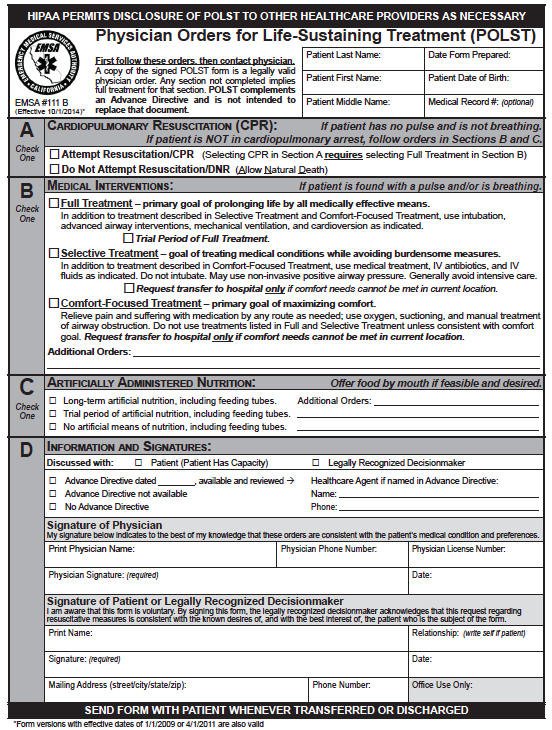
We were prepared for the end of life. Norma had a Physician’s Order for Life Sustaining Treatment (POLST) form dictating the level of care she wanted; no intubation or mechanical efforts to sustain her life. I had a Power of Attorney for health care. By three in the afternoon I noticed that the bag attached to the Foley catheter had collected no urine; Norma’s kidneys had shut down and she was actively dying. The echocardiogram report confirmed severe heart failure. My role then became to be her advocate.
Hospitals are about prolonging life, not ending it, but they have no choice but to honor a POLST document and its wishes. My job was to ensure her wishes were respected, and out of love, I did just that. I held her hand, and gradually her breathing slowed; on May 22, at six in the evening, it stopped. For me it was one of the hardest things I’ve ever had to do, but it was what she wanted.
Everyone needs an advocate when hospitalized, and for older folks, a POLST document is essential. Assigning the Medical Power of Attorney to a trusted friend, loved one or family member is necessary. If you have not done so, do it. It’s about what we must sometimes do for love.

It must have been so very painful to face that decision, knowing your obligation to Norma and having to resist the compulsion to perserve her life. I thank you for your constancy.